
Carries the groups' conscience
Through its G.S.R.s, the Assembly is the Area's “interim repository of the collective group conscience” — and the Delegate takes it to the General Service Conference.
Mid-Southern California Area 09
One of 93 areas of A.A.'s General Service Conference — linking the A.A. groups of Orange, Riverside and San Bernardino counties, Long Beach and the South Bay with A.A. as a whole, in English and Spanish.
22 Districts16 English-speaking · 6 Spanish-speaking
4 CountiesOrange, Riverside, San Bernardino and part of Los Angeles
21 Standing & coordinate committees19 standing · 2 coordinate
1958 Year the Area was formedAs “California Southern Coastal”
93 Areas in the U.S. and CanadaEach sends one Delegate to the Conference
15 Areas in the Pacific RegionFrom Alaska and Hawaii to Arizona
Who we are
Mid-Southern California Area 09 is one of 93 areas of the General Service Conference of Alcoholics Anonymous in the United States and Canada, and one of 15 areas in the Pacific Region. We serve the A.A. groups of Orange and Riverside counties, most of San Bernardino County, and the part of Los Angeles County south of Rosecrans Avenue — Long Beach, the South Bay, the Harbor area and Catalina Island.
The Area is how those groups take part in A.A. as a whole. Each group elects a General Service Representative (G.S.R.); the G.S.R.s meet in their districts; and at the Area Assembly they elect the Area officers, including a Delegate who carries the Area's conscience to the General Service Conference each spring and reports back.
Service to the Fellowship of Alcoholics Anonymous shall be the primary purpose of General Service in the Mid-Southern California Area.
Two languages, one Area
Spanish-speaking districts support the Spanish-speaking groups and English-speaking districts support the English-speaking groups, so the whole Area is covered by both. Groups that meet in other languages are supported by the English-speaking district where they meet.
Supported by A.A. members
The Area accepts contributions only from A.A. sources and carries out no fund-raising of any kind.
How to contributeWhere we serve
Area 09 covers all of Orange and Riverside counties, most of San Bernardino County, and the part of Los Angeles County south of Rosecrans Avenue — including Long Beach, the South Bay, the Harbor area and Catalina Island.
Each pin marks where a district holds its business meeting. Select a pin to open that district.
What the Area does
Through its G.S.R.s, the Assembly is the Area's “interim repository of the collective group conscience” — and the Delegate takes it to the General Service Conference.
Every two years the Assembly elects seven Area officers, including the Delegate, by the Third Legacy Procedure.
Assemblies and Area Service Committee meetings rotate among the districts, in person and online.
Area committees reach professionals, correctional and treatment facilities, the public, older alcoholics, remote communities and young people.
The Pre-Conference workshop, the Foro and the Servathon — hosted by districts on the Area rotation.
Minutes, motions and reports are published in English and Spanish, and the Archives Committee keeps the Area's history.
How it is organized
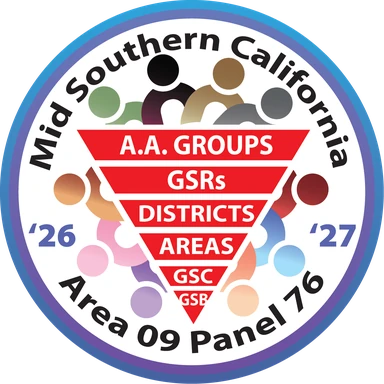
Our Panel 76 logo is A.A.'s service structure turned upside down: the groups are on top, because in A.A. final authority rests with the groups.
G.S.R.s, district officers, committee chairs, Area officers and past Delegates. It elects the officers, including the Delegate, seeks substantial unanimity on important decisions, and meets at least three times a year.
Assemblies and ASCsDistrict officers, committee chairs, Area officers and past Delegates meet between Assemblies to discuss issues, gather each district's conscience and set the next Assembly's agenda. G.S.R.s are strongly encouraged to attend.
Area businessSeven trusted servants form the Executive Committee: Delegate, Alternate Delegate, Chair, Secretary, Treasurer A/P, Treasurer A/R and Registrar. They are elected in October of odd-numbered years and serve two-year terms.
Meet the current panelSeventeen standing committees — from Archives and Literature to Public Information, Corrections and Treatment — and two service schools (GSR School and DCM School), plus two coordinate committees: Intergroups/Central Offices and Hospitals & Institutions.
All committeesThe G.S.R.s of each district elect a D.C.M. Larger districts have sub-districts, each with its own D.C.M., and a D.C.M.C. who chairs the district and links it to the Area.
All districtsGoes to the General Service Conference each spring “prepared to express the ‘conscience’ of the Area”, votes in the best interests of A.A. as a whole, and reports back to the Area.
Delegate's cornerWhen we meet
Area meetings rotate among the districts, so each month a different district is the host.
This is the usual pattern. Each year's dates, places and host districts are set in the approved Area calendar.
History
A few milestones from the Area's own history, “The Chronicles of Mid-Southern California Area 09”, written by the Archives Committee.
Approved by the 8th General Service Conference in April 1958, the new area was carved out of the California Southern Area at an assembly in Santa Ana on September 7 — as “California Southern Coastal”, with 10 districts and 105 G.S.R.s.
The Area's first Delegate attends the 9th General Service Conference.
The 3rd A.A. International Convention comes to Long Beach, with Bill W. and Ebby T. About 14,000 A.A.s light matches at the closing meeting.
Districts 11, 12 and 13 are created. (District 13 later merges with District 2, and District 11 is now part of District 8.)
Southern Coastal California becomes Mid-Southern California — MSCA 09.
The Area holds its first Servathon in January 1973.
The Pacific Region A.A. Service Assembly meets in Anaheim — and again in Irvine in 2004.
The Archives Committee is formed, and the Area newsletter begins to be translated into Spanish.
District 20 is created to serve all of the Spanish-speaking meetings in the Area.
Written in Area 09 by Goldene L. and accepted by the Area Assembly.
The Spanish-speaking districts start the annual FORO de MSCA, focused on general service.
MSCA 09 writes to G.S.O. asking for a Spanish-language Grapevine — a step toward La Viña.
Area 09 Archives co-hosts the 7th National Archives Workshop in San Bernardino with Areas 05, 08 and 93.
District 25 is created from District 24, completing today's six Spanish-speaking districts, 20 to 25.
The Archives Committee moves into its current repository in Riverside.
Sources: The Chronicles of Mid-Southern California Area 09 (Archives Committee, 2009) and the Area Guidelines, Revision P (2023). Members are named by first name and last initial.
Read at our meetings
Read at the start of most A.A. meetings
Alcoholics Anonymous is a fellowship of people who share their experience, strength and hope with each other that they may solve their common problem and help others to recover from alcoholism.
The only requirement for membership is a desire to stop drinking. There are no dues or fees for A.A. membership; we are self-supporting through our own contributions. A.A. is not allied with any sect, denomination, politics, organization or institution; does not wish to engage in any controversy, neither endorses nor opposes any causes. Our primary purpose is to stay sober and help other alcoholics to achieve sobriety.
Written in Area 09 in 1986
We are the General Service Representatives.
We are the link in the chain of communication for our groups with the General Service Conference and the world of A.A.
We realize the ultimate authority is a loving God as He may express Himself in our Group Conscience.
As trusted servants, our job is to bring information to our groups in order that they can reach an informed group conscience.
In passing along this group conscience, we are helping to maintain the unity and strength so vital to our fellowship.
Let us, therefore, have the patience and tolerance to listen while others share, the courage to speak up when we have something to share, and the wisdom to do what is right for our group and A.A. as a whole.
From the group to the General Service Board.
Officers, committee chairs and D.C.M.C.s, with service addresses.
Find your district and its business meeting.
What each Area committee does and how to help.
Assemblies, agendas, motions and minutes.
A role-based address for every service position.
Search is available on the published site. (It is built after the pages.)